There are cities you recognize by their skyline. Nashville you recognize by its glow.
Stand at the corner of Broadway and 2nd Avenue (aka The Neon Canyon) after dark and you'll understand immediately. The neon comes at you from every direction — guitars and cowboy boots and names you know, names you're about to know, all of it buzzing and crackling in that particular frequency that only glass tubes filled with gas can produce. It is, by any measure, one of the great light shows in American city life.
But Nashville's neon is not just decoration. It's history. And we know that firsthand — because some of that history belongs to our family.
A Personal Note Before We Begin
Robinette's family owned Weiss Liquors — one of Nashville's most storied institutions and home to what may be the single most beloved neon sign in the entire city.
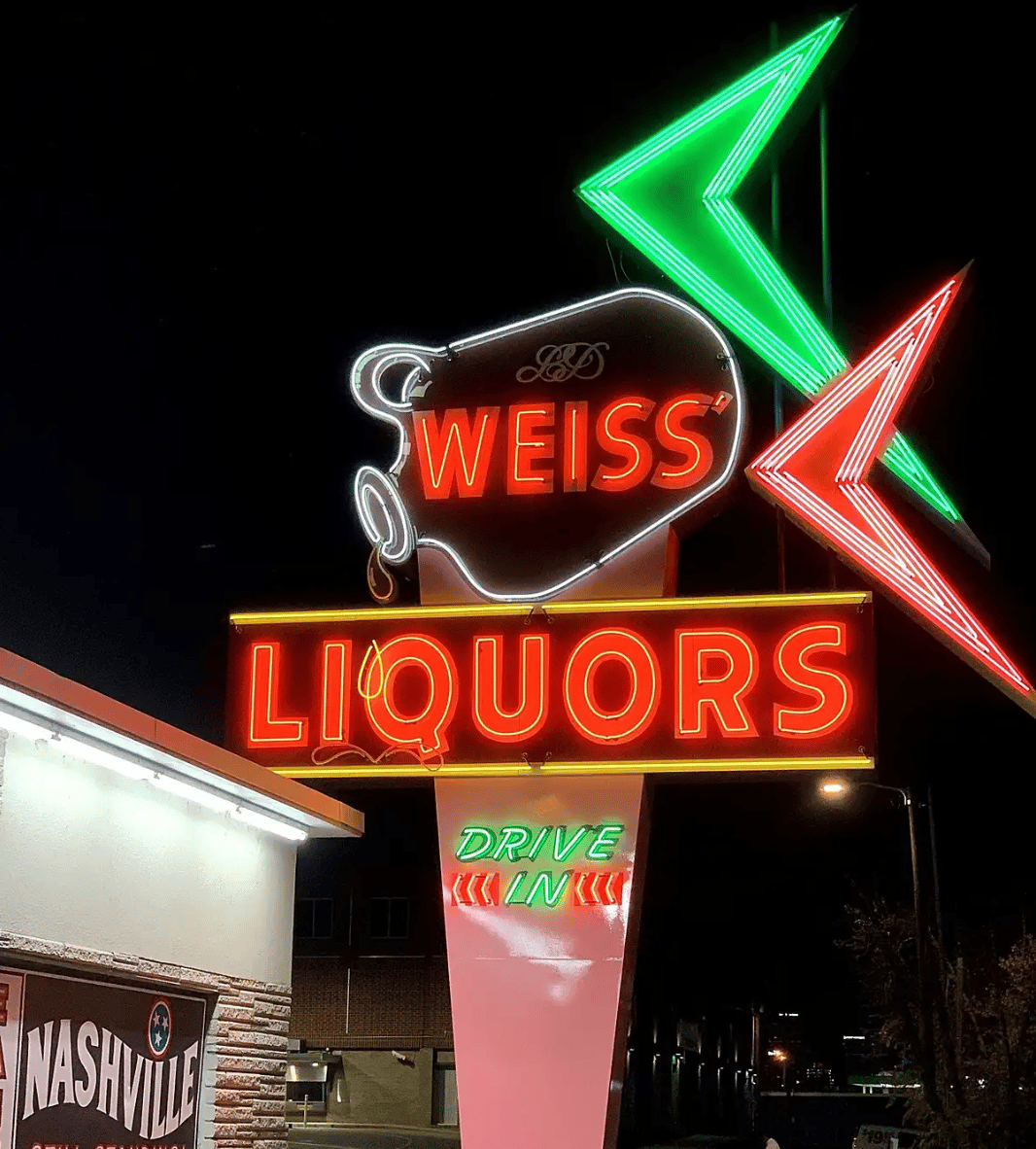
Robinette's grandfather started his liquor business in downtown Nashville on North First Street in 1936 shortly after prohibition was lifted. The store later moved to Main Street and Cummings Signs designed a magnificent 30-foot overturned jug pouring animated neon liquor drops — became one of the defining images of East Nashville.
Weiss' neon sign has been the backdrop for many a Nashville musician's press photos, as well as being featured in the Hollywood film Redemption Road, where actor Luke Perry leaned against the hood of a car channeling James Dean — with the neon lights of Weiss Liquors glowing behind him. It was also featured in the it show, Nashville. Google it and you'll find loads of photos. Artists have recreated the sign on canvas in oil and acrylics. One super fan has a tattoo on her arm.
The sign was damaged during the tornado that went through downtown in 1998. Then came March 3, 2020, days before the pandemic gripped our world. A violent tornado ripped through Main Street after midnight and crumpled the sign into an unrecognizable mess. It almost felt like a death.
But East Nashville does not give up easily. Nick Redford of Fortify, a design and fabrication shop, rushed over to Weiss Liquors as daylight rose to offer help. Third-generation owner Anne Nicholas Weiss (yes, Robinette's baby sister) immediately focused to restore the sign, not an option. Redford worked 100-hour weeks to get it done. "Many a night I laid awake thinking, 'I have to get this right on behalf of Nashville,'" he said. He asked local second-generation neon artist David Rivers to re-create the neon jug, drops, and splash, animated again after more than a decade of being static.
On the Saturday after Thanksgiving in 2020, a small, masked crowd stood in a liquor store parking lot waiting for the 30-foot-tall neon sign to light up. For East Nashville, it was more than a sign coming back on. It was a signal that the neighborhood was still standing.
We think about that sign often. It's a piece of our family's history — and a perfect example of what Nashville neon actually means to the people who live here.
How It Started: Broadway Before the Glow
Nashville became the hub of country music in the middle of the 20th century, with Broadway emerging as the city's honky-tonk capital. Performers kept flocking to Broadway to showcase their talents in small clubs and honky-tonk bars that offered an up-close experience with performers and plenty to drink at an affordable rate.
These were not glamorous establishments in the beginning. They were working bars for working musicians — places where someone who had just stepped off a bus from rural Tennessee with a guitar and a dream could get in front of an audience the same night. The music was the draw. But the signs were the invitation.
Neon signs took center stage as they were used to attract visitors and create a unique identity for each honky-tonk bar, creating the vibrant and inviting party aesthetic that Broadway is known for. Each establishment needed to stand out on a street full of establishments. Neon was the answer — bright enough to be impossible to ignore, and expressive enough to carry personality. A good neon sign on Broadway wasn't just a business decision. It was a statement of identity.
The Street That Became a District
Lower Broadway is lined with a mixture of one- to four-story contemporary and Victorian Revival brick buildings. The area's fame comes from its honky tonks with large-scale signage consisting of vibrant graphics, neon guitars, cowboy boots, and country music décor, most often attached to the facades of the buildings and overhanging the sidewalk. The modest retail shops, honky-tonk bars, studios, restaurants, and offices all transform at night when the neon signs are illuminated. Lower Broadway forms part of the Broadway Historic District, which was listed in the National Register of Historic Places in 1980.
That National Register designation is significant. It means the character of Lower Broadway — including the signage tradition that defines it — has been recognized as genuinely historic. The neon lights of Broadway aren't just atmosphere. They're part of the documented cultural heritage of American music.
The Signs That Made History
Some of Broadway's neon has its own story within the larger story.
The most famous blade sign on Lower Broadway — now displayed at Garth Brooks' Friends in Low Places Bar — has a history that predates country music tourism entirely. The blade sign belonged to the Heilig-Meyers furniture store, which operated in the space at 411 Broadway for decades. The company closed the last of its stores in 2001, and even though Nashville city ordinances now prohibit signs of that size, the sign was preserved and reimagined. It's the largest neon sign on Lower Broadway — and it was originally advertising furniture.
Then there's Tootsie's Orchid Lounge, perhaps the most recognized name in Nashville honky-tonk history, with its unmistakable purple-painted brick facade anchoring the corner of Broadway and 5th since the 1960s. Tootsie's back door famously opened onto the alley behind the Ryman Auditorium — meaning the biggest names in country music were regulars. The neon orchid sign out front became one of the most photographed images in Music City.
What Neon Means to Nashville Now
The neon tradition on Broadway has not diminished with time. If anything, it has accelerated.
Morgan Wallen's This Bar opened in May 2024, complete with 6 stories of neon lights and country music. Eric Church's Chief's features 6 distinct floors including a 2-story ticketed music venue, dining rooms, and a rooftop bar. Post Malone's Posty's, Broadway's newest bar, opened in July 2025 with 6 bars, 3 live music stages, and dining options.
Each new venue has arrived with its own interpretation of the neon tradition — more elaborate, more architectural, more ambitious than what came before. The artists who've put their names on Broadway understand something the original honky-tonk operators understood intuitively: in Nashville, your sign is part of your identity. The glow matters.
Beyond Broadway: The Rest of Nashville's Neon Story
Broadway gets the attention, but Nashville's relationship with neon extends well beyond Lower Broadway — and Weiss Liquors is proof of that.
The neon signs that once lit up Jefferson Street — Nashville's historically Black entertainment district just north of downtown — told an equally important story. In the mid-20th century, Jefferson Street was where B.B. King, Jimi Hendrix, and Etta James performed for Nashville's Black community, in venues that rivaled anything on Broadway in energy and talent. Much of that district was razed by urban renewal and interstate construction in the 1960s, taking its neon with it. It's one of Nashville's great cultural tragedies and one that historians and preservationists have worked hard to document and remember.
Today, Nashville neon can be found in unexpected corners of the city. In East Nashville, the Weiss Liquors sign at 824 Main Street stands as proof that great neon is worth fighting for. In the Gulch and Midtown, boutique restaurants and bars have embraced custom neon as a design element. In Five Points, hand-crafted signs give character to a neighborhood that has always done things its own way. And in Sylvan Park — our neighborhood — Edley's invested in neon as well. It's a reminder that this tradition was never limited to the tourist corridor.
Why This Matters for Nashville Real Estate
If you're wondering what Nashville neon has to do with real estate, the answer is: everything.
The character of a city — the things that make it feel irreplaceable rather than interchangeable — is built from exactly these kinds of details. The neon signs on Broadway, the Weiss Liquors jug pouring its animated drops over East Nashville,are the physical expressions of what Nashville is. A city built on music, on family businesses, on the belief that what you put on your building says something about who you are and what you stand for.
When people move to Nashville — and they continue to arrive daily — they are not moving to an abstraction. They are moving toward something specific: the feeling of a city with genuine culture, genuine history, and genuine character that cannot be manufactured from scratch.
We know that character well. Our family helped build a small piece of it — one glowing jug at a time.
PS. Neon DOES exist beyond Broadway, be on the lookout for these gems
Looking for your own custom neon? Try https://joslinsign.com/